Technical Article
12 min read
Earthquake Resistance in Cyprus
Learn how Smart-Timber™ design responds to the real seismic conditions of Cyprus.


The initial price is only the beginning. A home’s true value is revealed by how it performs over time.
The lowest initial price does not necessarily mean the best value. A home is a long-term investment, and its true value is influenced by the structural system, the quality and specifications of materials and equipment, energy performance, durability, maintenance requirements and overall construction quality.
For this reason, a meaningful comparison between different construction proposals should not be limited to price per square metre. A Life-Cycle Cost (LCC) approach looks beyond the initial investment to consider costs associated with operation, energy use, maintenance and, where applicable, replacement over time.
At ÖKOHAUS GER, value is approached through the integrated Smart-Timber™ system. The selection and treatment of structural materials, controlled quality standards for construction materials and equipment, factory-controlled production, energy performance and technical design work together with one objective: to deliver lasting value throughout the life of the home.
The true value of a home is not determined only by how much it costs to build, but by the quality, performance and value it continues to provide to the homeowner over time.
The total cost associated with a building over time, which may include the initial investment, operation, energy use, maintenance and future replacements.
The price per square metre provides a simple starting point for comparing quotations. On its own, however, it does not reveal what the homeowner is actually purchasing or whether two quotations relate to homes of comparable quality and technical specification.
Two homes of the same size may differ significantly in their structural system, the quality and treatment of materials, energy performance, windows and doors, equipment, level of technical supervision and quality of workmanship. The scope included in the stated price may also differ considerably, along with any additional costs required before the home is completed.
For this reason, at ÖKOHAUS GER we believe that a meaningful comparison must be based on equivalent specifications and a comparable level of completion. Smart-Timber™ was not designed solely to achieve the lowest possible construction price, but to combine controlled quality, energy performance, durability and long-term functionality within an integrated home-building system.
A lower price per m² is not necessarily the better financial choice, just as a higher price does not, by itself, prove superior quality. The true relationship between quality and cost becomes clear when we understand what each proposal includes, the specifications to which the home will be constructed and what it will continue to provide after handover. The critical question before comparing two prices is whether they genuinely relate to two comparable homes or are simply two different prices per square metre.
The initial construction price divided by the floor area of the home. It becomes a meaningful comparison indicator only when quotations refer to equivalent specifications, quality and levels of completion.
Construction is only the beginning of the financial life of a home. After delivery come decades of use, during which energy costs, maintenance and potential repairs or replacements may arise.
This is why an assessment based on Life-Cycle Cost can provide a more meaningful picture than a comparison based solely on initial price. Life-cycle evaluation can include acquisition costs, energy use, maintenance and other expenditure arising during the service life of a building.
A home requiring a higher initial investment may, in certain circumstances, prove more economical over time if it delivers better energy performance, lower operating requirements or reduced maintenance needs. A meaningful assessment should therefore be based on actual characteristics rather than the initial price alone.
The cost required for the construction and completion of the home before normal use begins.
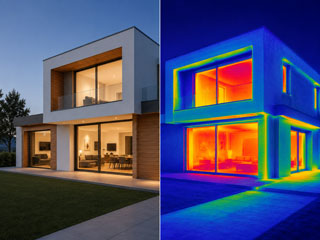
Energy performance directly affects the operation of a home for many years. In the climatic conditions of Cyprus, where cooling is an important requirement for a significant part of the year, the performance of the building envelope is particularly important.
In Smart-Timber™, thermal performance is treated as a characteristic of the complete system rather than as an isolated addition. The wall assembly, thermal insulation and energy-efficient openings work together to limit unwanted heat transfer.
For the homeowner, this means that energy performance should be considered when comparing two financial proposals. The difference in purchase price occurs once; differences in the operating performance of a home can continue year after year.
The external elements of the home that separate and protect the indoor environment from external conditions.
Durability affects both the functional quality of a home and its financial impact over time.
In the Smart-Timber™ system by ÖKOHAUS GER, the load-bearing structure is constructed from C24 structural timber, kiln-dried under controlled conditions and industrially treated before being incorporated into the construction. Long-term protection is not based on a general claim about timber, but on how the specific structural timber is selected, treated and incorporated into the integrated Smart-Timber™ system.
At the same time, ÖKOHAUS GER’s approach to quality extends beyond the load-bearing structure. Materials, construction components and equipment are selected with an emphasis on quality and their long-term performance within the completed home.
This has a direct relationship with cost. The need to maintain, repair or prematurely replace individual components may not appear in the initial purchase price, but it forms a real part of the total cost of ownership.
The primary structural framework that supports the home and safely transfers its loads.
The market offers different construction approaches — from conventional construction and metal frame systems to different timber construction methods and SIP systems. Differences in initial price are to be expected because these homes do not necessarily have equivalent specifications, materials, equipment, quality-control processes or levels of completion.
What matters to the homeowner is not to classify one method in advance as “cheap” or “expensive”, but to examine exactly what each proposal includes and what quality of completed home will ultimately be delivered.
For the same reason, ÖKOHAUS GER does not position Smart-Timber™ simply as a generic “timber construction”. It is the company’s specific integrated system, in which the quality of structural materials, construction components and equipment is controlled and incorporated into an overall technical approach focused on quality, energy performance and long-term durability.
At ÖKOHAUS GER, the relationship between quality and cost is not approached as an exercise in achieving the lowest possible initial price.
Our approach is based on selecting high and controlled specifications where they materially influence the quality, performance and longevity of the home. The structural system, materials, construction components, energy performance and equipment are evaluated as parts of the same integrated home.
For a prospective homeowner, the key points worth evaluating are:
The financial assessment therefore moves beyond the simple question:
“How much does it cost?”
to the more meaningful:
“What am I actually getting for the money I invest?”
The quality experienced by the homeowner every day extends beyond the load-bearing structure. It includes windows and doors, finishes, installations, equipment and the components used in everyday life.
At ÖKOHAUS GER, the selection of these elements is not treated solely as a matter of appearance or initial price. Their quality, suitability and expected long-term performance form part of the overall assessment of the home.
At the same time, a premium finish alone cannot transform an average underlying construction into a home of high overall quality. The right priorities begin with those elements that are difficult and costly to change later: the structural system, building envelope, energy performance and construction quality.
Finishing choices can then be adapted to the homeowner’s aesthetic preferences and budget without compromising the fundamental technical quality on which the home has been designed.
| What to Compare | What the Homeowner Should Check | Why It Matters |
|---|---|---|
| Initial Price | Exactly what is included — and, importantly, what is not included | A lower initial price may not represent the true cost of completing the home |
| Structural System | Materials, design and overall construction approach | Influences the fundamental quality and performance of the home |
| Quality of Materials & Equipment | Specifications, quality and suitability for long-term use | Influence performance, durability and potential future replacement |
| Energy Performance | Building envelope, thermal insulation and openings | Influences comfort and operating costs |
| Durability | Material specifications and the overall approach to protection | Influences long-term performance |
| Maintenance | Expected requirements during use | Forms part of the true cost of ownership |
| Construction Quality | Control and consistency of implementation | A good specification only has value when it is correctly implemented |
| Level of Completion | Which works, materials and equipment are included and which additional costs remain | Costs introduced later can significantly increase the final budget |
| Support | Who takes responsibility for the project and what is provided after delivery | Influences the security of the overall investment |
The true relationship between quality and cost in a home cannot be expressed solely by the initial price or by a figure per square metre.
A complete assessment considers what the homeowner is purchasing today and what the home will continue to provide in the years ahead: structural quality, the quality of materials and equipment, energy performance, durability, maintenance requirements, construction quality and support.
This is also the philosophy behind Smart-Timber™ by ÖKOHAUS GER. We do not aim to present the home as the cheapest option. Our objective is to deliver meaningful value for the homeowner’s investment through high and controlled specifications and an integrated system designed for quality, performance and long-term durability.
Equally important, a true comparison should be based on the completed home that will actually be delivered and the real cost required to reach that stage, rather than only the initial figure shown in a quotation.
The right question, therefore, is not simply “How much does the home cost?”, but “What home am I getting for that investment — what exactly does the price include, and what will it continue to offer me over time?”
European Commission — Life-Cycle Costing
European guidance for assessing life-cycle costs and the environmental performance of buildings.
European Commission JRC — Level(s): Life-Cycle Costing
Level(s) tools for applying life-cycle assessment and long-term cost analysis to buildings.
European Commission — Energy Performance of Buildings
EU framework for improving the energy performance, renovation and operation of buildings.
ISO 15686-5:2017 — Buildings and Constructed Assets — Service-Life Planning — Life-Cycle Costing
International standard for service-life planning and life-cycle costing of buildings.
ÖKOHAUS GER — Smart-Timber™ Technology
Overview of the technological and construction approach behind the Smart-Timber™ system.
Discover more technical analyses, comparisons and useful insights into the construction, energy performance and functionality of a Smart-Timber™ home.
Fill in your details and our team will contact you to discuss your project.
Your information is secure and will not be shared