



The concept of value-for-money is crucial when investing in a new home. What truly matters is not only the initial construction cost but also the total lifetime cost: maintenance, energy efficiency, durability, and resale value. At ÖKOHAUS GER, we demonstrate in practice that quality and resilience are not a privilege for the few but a smart choice that ensures long-term benefits.
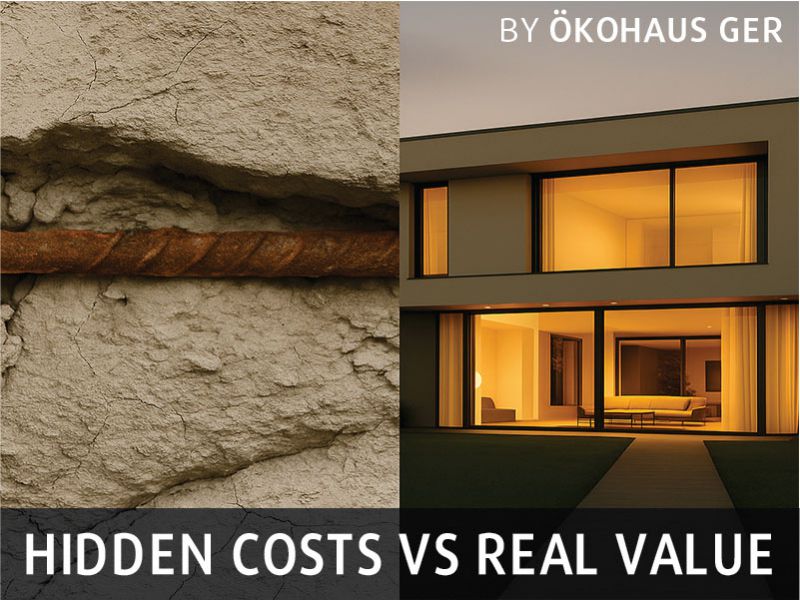
Conventional concrete houses in Cyprus face serious challenges that significantly increase their “real” cost and reduce their overall value-for-money. Due to high humidity levels—especially in coastal regions—as well as the lack of strict regulations and consistent quality testing of concrete, the material often develops cracks over time. Daily temperature fluctuations further accelerate the process: the steel reinforcement corrodes, expands, and creates new cracks. This leads to a continuous and slow reduction of the building’s structural safety, posing additional seismic risks. Repairs can only slow down the damage and come at high financial and emotional cost, without restoring the original strength of the material. Over the years, these recurring interventions turn RC homes into a low value-for-money option.
Steel houses are often promoted as a modern solution, but their long-term costs are equally demanding. Metal is prone to corrosion, especially in coastal areas, requiring frequent and expensive maintenance. Thermal expansion and contraction cause gradual loosening and deformation at joints, while welded or bolted connections demand regular inspections. Fire protection is mandatory and costly, as steel quickly loses strength under high temperatures. Combined with the heavy reinforcements needed for long-term stability, these requirements significantly increase the total cost of ownership. While the upfront cost may appear moderate, the overall value-for-money remains low.
Their low initial cost is often a trap. Without certified timber, proper insulation, and factory-controlled assembly, these structures face higher risks of insect damage, mold, or deformations. While they may seem economical at first, the expenses of repairs, energy losses, and premature wear make the total lifetime cost disproportionately high compared to the initial investment.
In the Cypriot market, some housing solutions are based on imported pre-manufactured closed wall panels. These walls arrive fully assembled from abroad, leaving no opportunity for clients to verify what is inside them. This raises serious concerns regarding transparency: there is no guarantee that the timber is truly certified, properly treated, or free from moisture, fungi, or insect problems hidden inside. The result is an increased risk of high lifetime costs and unpredictable damage, since potential issues cannot be detected early or easily repaired.
At first glance, Structural Insulated Panels (SIPs) may seem cost-effective, but their PIR/EPS insulation core is prone to aging and moisture issues, with repairs being difficult or even impossible. The absence of ventilation and inspection options makes it hard to prevent damage in time. As a result, while they might appear competitive in upfront cost, their long-term value-for-money is weakened.
Our homes combine C24 certified timber, factory precision, and high-performance insulation. This results in:
Another differentiating factor of ÖKOHAUS GER homes is the use of high-quality thermal façade and finishing systems. These provide protection against weather, mechanical stresses, and surface cracks while also enhancing aesthetics and durability. Combined with proper material layering and factory-controlled assembly, this investment significantly extends the lifespan of the home, reduces maintenance costs, and increases the overall value of ownership.
| System | Initial Cost | Maintenance Cost | Durability | Overall Value-for-Money |
|---|---|---|---|---|
| Reinforced Concrete (RC) | Moderate | High | Medium | Low |
| Steel Constructions | Moderate | High | Medium | Low |
| Unofficial Timber Constructions | Low | Very High | Low | Very Low |
| Timber Houses with Imported Closed Wall Systems | Moderate | High | Low | Low |
| SIP Panels | Moderate | High | Medium | Medium |
| ÖKOHAUS GER Timber Frame | Competitive | Very Low | Very High | Excellent |
Investing in an ÖKOHAUS GER home is not just about the initial price. In practice, the cost-to-quality ratio proves that we offer the most reliable and economically efficient option. Our clients are not simply buying a house – they are investing in safety, longevity, and true value.
Fill in your details and our team will contact you to discuss your project.
Your information is secure and will not be shared


